Skip to content

Versa

The Evolution of Logistics Identification Standards

    (And Why They Are Becoming a Strategic Lever for Operational Control)

    Understanding history helps anticipate technological evolution and gain a competitive edge in the market. And even when we understand it, putting it into words and documenting it is even better.

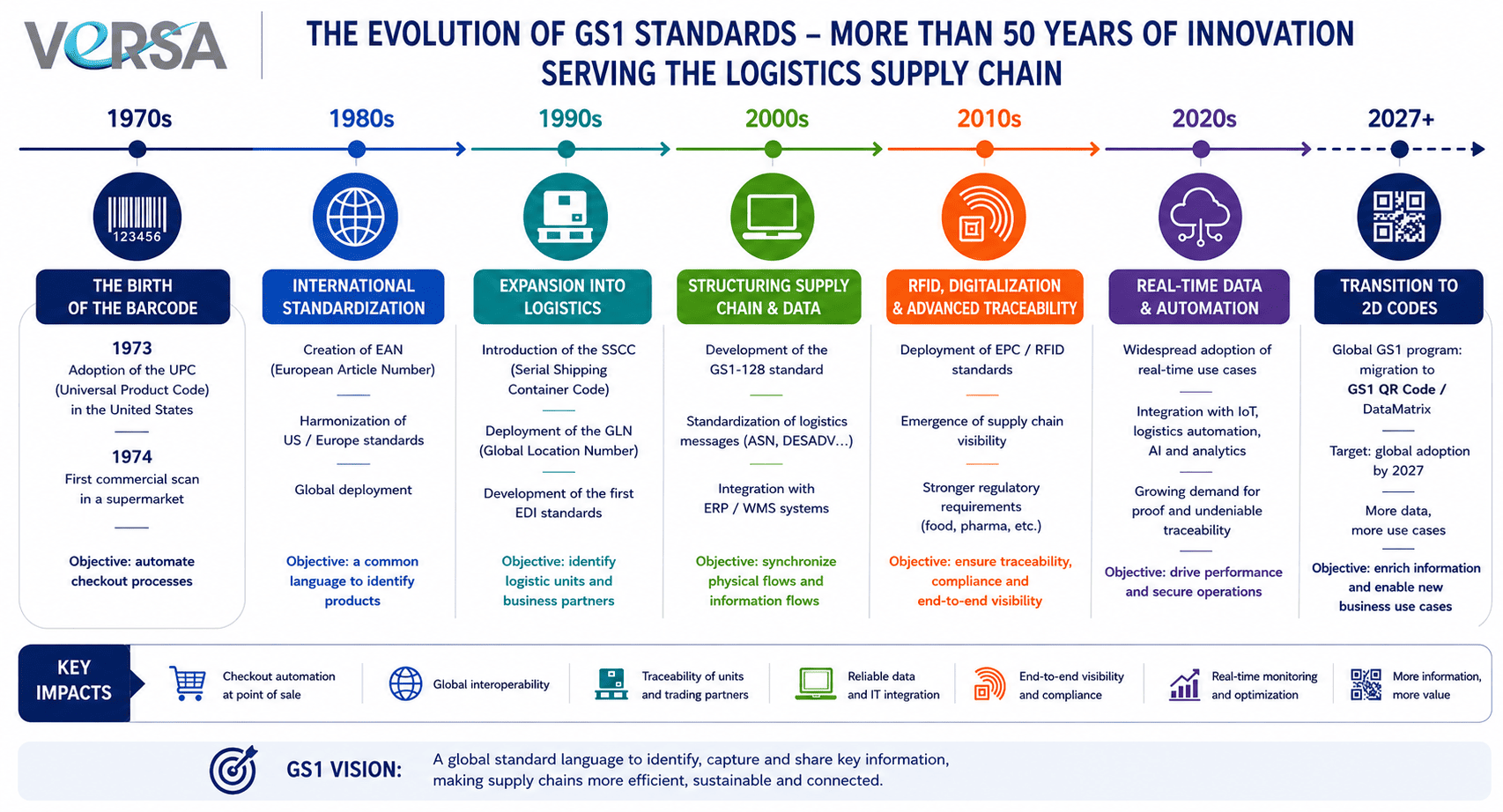
    Today (2027), a small revolution is taking place in the logistics world with the arrival of the “2D barcodes” program. You probably already know about it… but just in case 😊

    What makes this evolution particularly interesting is that we are moving from simple identification to enriched data capable of supporting analysis, operational control, optimization, automation… and even communication.

    From “Support Identification” to Structured Identification

    Historically, logistics identification had a simple purpose: recognizing a unit (pallet, carton, parcel, etc.) so it could move through a physical flow.

    Today, this logic has evolved dramatically. Identification standards have become a foundational layer for industrial and logistics management.

    The central standard remains the SSCC (Serial Shipping Container Code) defined by GS1.
    👉 Introduced into GS1 standards in the 1990s and widely adopted throughout the 2000s, it is now the global reference standard.

    In practical terms, the SSCC makes it possible to:

    • assign a unique, global, and unambiguous identifier to each logistics unit
    • remain independent from the content itself (unlike a product GTIN)
    • be encoded in barcodes (GS1-128) or RFID
    • create a direct link between physical flows and information flows

    🔗 Source : GS1 – SSCC overview 

    👉 We no longer simply “label” a pallet: we assign it a legally reliable digital identity, similar to a license plate in the physical world.

    The Shift from Linear Barcodes to Rich Data Carriers (2D, RFID)

    👉 This evolution is officially driven by GS1, notably through the “2D barcodes” program targeting global adoption by 2027.

    👉 The identification medium is becoming a true data carrier rather than a simple label.

    The limitations of traditional linear barcodes (such as GS1-128) are now well known:

    • limited data capacity
    • dependency on visibility and print quality
    • difficulty supporting advanced use cases

    For several years now, the industry has been transitioning toward richer identification technologies.

    Main Evolutions

    2D Codes (GS1 DataMatrix, GS1 QR Codes)

    → allow significantly more information to be embedded in a smaller space

    RFID / EPC (Electronic Product Code)

    → no visual contact required
    → simultaneous reading of multiple units
    → automation of logistics controls

    From “Static Identification” to Real-Time Data

    The most significant transformation is not only about format… but about how identification is used.

    Today, standards such as the SSCC are used to:

    • link each logistics unit to an ASN (Advanced Shipping Notice)
    • automate receiving and inspection processes
    • generate execution proofs (loaded, shipped, received, timestamped)
    • feed operational KPIs (quality, productivity, reliability)

    👉 The SSCC becomes a synchronization key between systems:
    WMS, ERP, TMS, and industrial automation systems.

    👉 Identification is no longer used simply to recognize a flow — it is used to prove it and manage it.

    🔗 Source :

    • GS1 Logistics Handbook (dernière version disponible en 2020, toujours référence)
    • McKinsey – Supply Chain Visibility (2022) : https://www.mckinsey.com/capabilities/operations/our-insights/supply-chain-visibility

    Standardization + Automation = Industrial Prerequisite

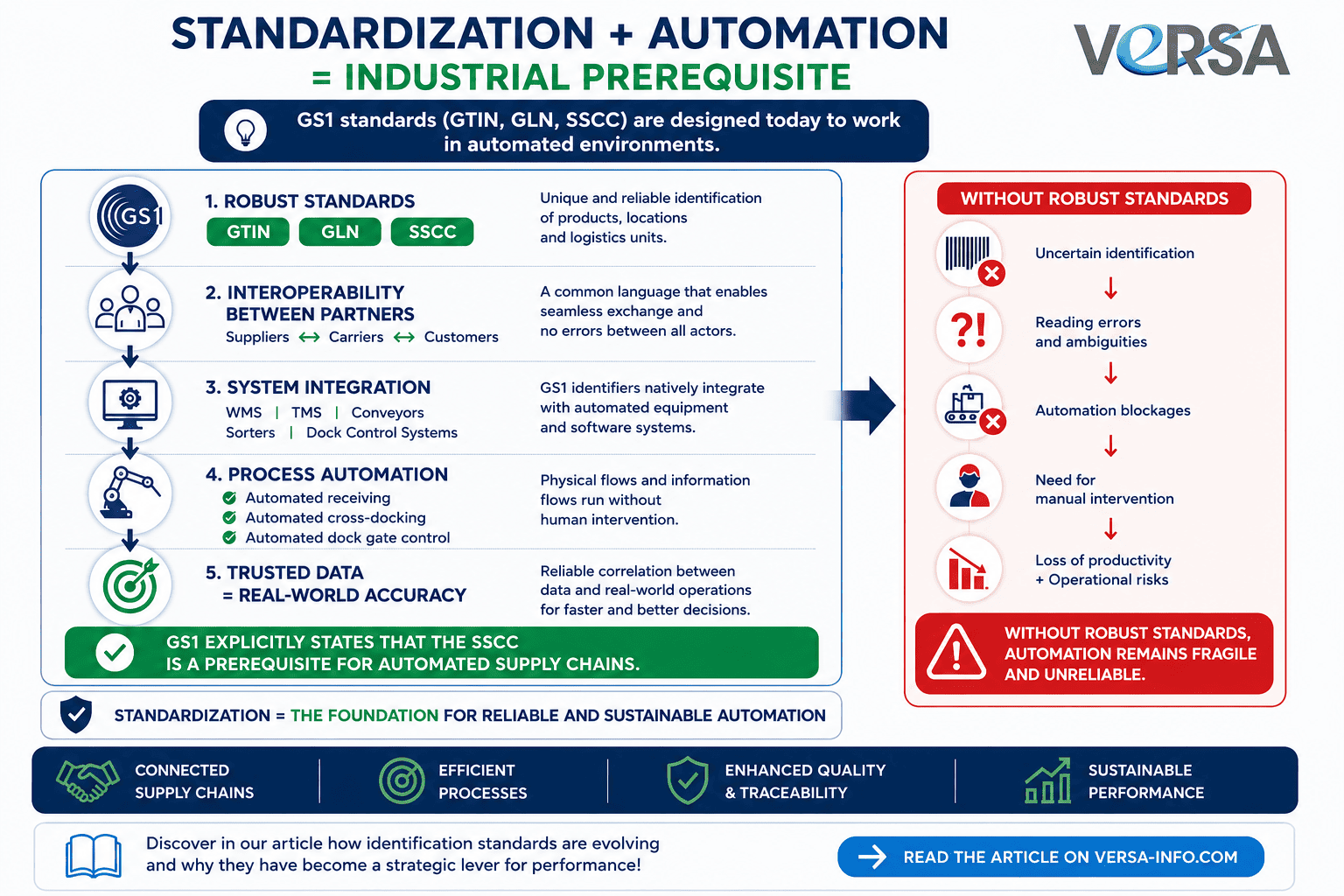
    GS1 standards (GTIN, GLN, SSCC) are now specifically designed to operate in automated environments.

    They enable:

    • interoperability between partners (suppliers, carriers, customers)
    • integration with automated systems (conveyors, sorters, dock control systems)
    • implementation of processes without human intervention

    In practical terms, this makes possible:

    • automated receiving and cross-docking
    • automated dock control
    • reliable correlation between operational data and physical reality

    👉 GS1 explicitly states that the SSCC is a prerequisite for automated supply chains.

    👉 Without robust standards, automation remains fragile and unreliable.

    🔗 Source :

    What Is Really Changing Today

    (And Where VERSA Is Naturally Aligned)

    The real evolution is not about technology itself — it is about a paradigm shift.

    We are moving:

    • from labeling → to legally reliable proof
    • from identification → to actionable data
    • from human scanning → to automated control
    • from traceability → to operational management

    In other words:

    Yesterday:

    “I can identify my products and pallets.”

    Today:

    “I measure, analyze, optimize, and ultimately control my operations.”

    This is precisely where integrated approaches come into play:

    • VERSA Automatisme → automation and control of physical flows
    • VERSA ABC-ABM Suite → capture of shop-floor data and reliable operational indicators
    • VERSA Logistic Suite → logistics control, proof generation, and legally reliable traceability of logistics flows

    👉 GS1 standards are becoming the backbone of data-driven industrial systems.

    Key Takeaways

    Logistics identification standards are no longer used simply to identify units.

    They are now essential for:

    • securing operations
    • generating reliable and legally defensible proofs
    • managing industrial and logistics performance in real time

    👉 Identification is no longer just a logistics tool.
    👉 It has become a strategic lever for controlling flows and operational risks